Why Do Bond Prices Fall When Interest Rates Rise?
The seesaw between rates and bond prices, explained with one simple example.
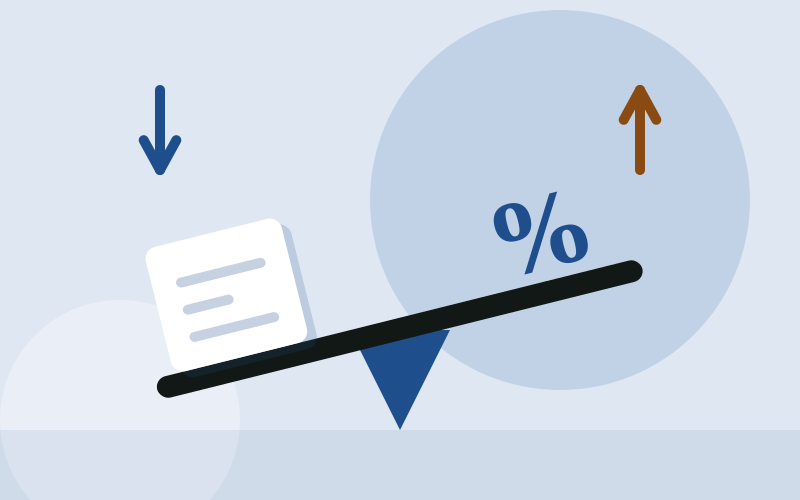
An existing bond pays a fixed rate. When new bonds start paying more, nobody will pay full price for the older, lower-paying one — so its price drops until its effective yield matches the market. When rates fall, the opposite happens.
What a bond actually is
A bond is a loan you make to a government or company. In return, the issuer promises to pay a fixed amount of interest — the coupon — on a schedule, and to return the original amount, the face value, on a set maturity date.
The key word is fixed. Once a bond is issued, its coupon doesn’t change, even if interest rates across the economy do. That’s what sets up the seesaw.
The seesaw, with one example
Imagine you own a bond with a $1,000 face value that pays 3% a year, or $30. Then rates rise, and new bonds just like yours pay 5%, or $50 a year.
If you tried to sell yours for $1,000, a buyer would simply choose the new bond and collect $20 more each year. To find a buyer, you lower your price until your $30 coupon, plus the gain at maturity, works out to roughly the same return as the new 5% bond.
Why some bonds move more than others
A bond that matures in 20 years locks you into its coupon far longer than one that matures next year, so its price reacts more strongly when rates change.
Bonds with lower coupons are also more sensitive, because more of their value arrives at the very end. Investors summarize this sensitivity in one number called duration.
What it means for your portfolio
If you hold an individual bond to maturity and the issuer doesn’t default, the price swings along the way don’t change what you get back. Price only matters if you sell early.
Bond funds never mature, so their share price moves with rates — but they also reinvest into newer, higher-paying bonds over time.
Price and yield always move in opposite directions. If you remember nothing else, remember the seesaw: one side up, the other side down.
Frequently asked questions
Can I lose money on a government bond?
Default risk is usually low for major governments, but you can still lose money if you sell before maturity after rates have risen.
Do rising rates ever help bond investors?
Yes. New money and reinvested coupons earn the higher rates, which can make up for the price drop over time.
This guide explains a general concept; it isn’t a recommendation to buy, sell or borrow. For decisions about your own money, consider speaking with a licensed financial professional.